Korean speaking app · Independent
Kkachi
Speak first, then check.
- Status
iOS app · awaiting App Store release
- Built with
- React Native / Expo, TypeScript, On-device speech recognition, Spaced repetition (SM-2)
Kkachi is not deployed yet. This page describes the system as built so far and what it's for, not a launched product.
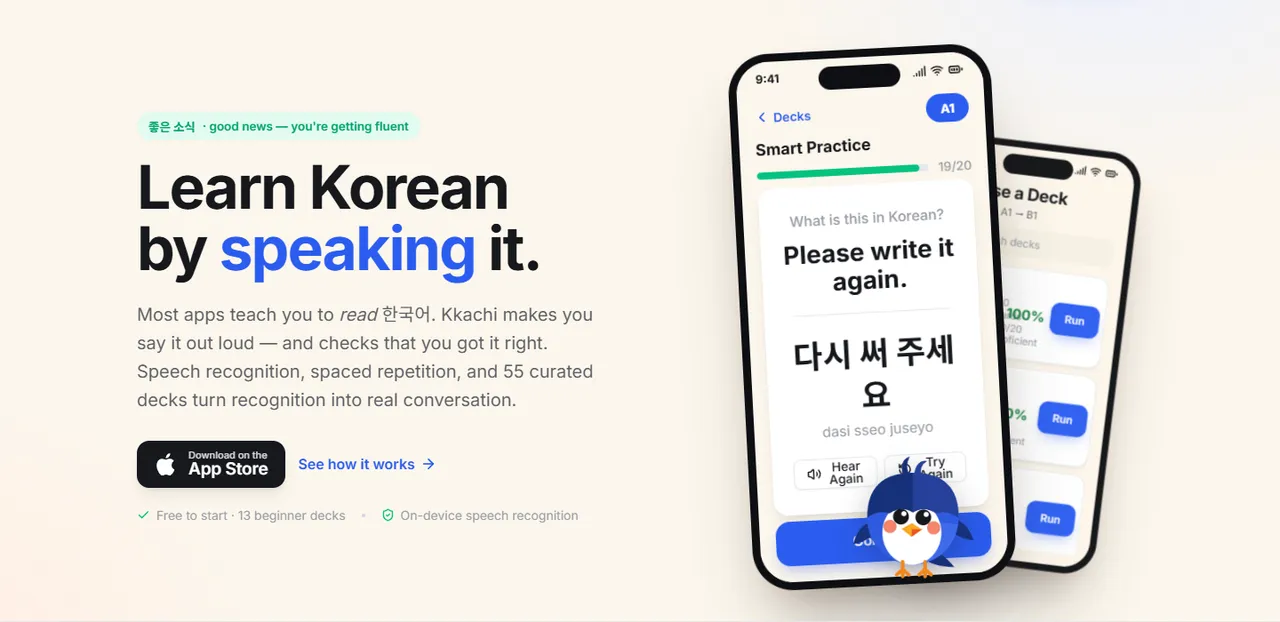
A Korean flashcard app you answer out loud. On-device speech recognition grades each answer, and spaced repetition brings missed cards back. 55 decks run from A1 to B1.
Problem
Most flashcard apps are good at exposure and weak at use. Recognizing a phrase on a screen is not the same as producing it out loud.
Insight
Put speaking at the center of the loop: see a prompt, say the Korean, get graded, move on. Then stop asking learners to decide what to study. Smart Review builds each session from the cards you recently missed, the cards due for review and new vocabulary at your level.
What I built
Three practice modes: Recall (see the English, say the Korean), Listen (hear Korean, pick the meaning) and Shadowing (repeat a native-speed phrase).
Speech recognition that runs on the phone, so no audio is sent to a server. It accepts common pronunciation variants, including tense and aspirated consonant differences.
A modified SM-2 spaced-repetition schedule, streaks and per-deck proficiency, and Korean Runner, a game mode where you say the answer to jump each flashcard gate.
55 decks across A1, A2 and B1, each built around one grammar point or theme. The 13 A1 decks are free; the rest are Premium.
It started as a web prototype and was rebuilt in React Native for iOS, with a product site at kkachikorean.com.
My role
Product concept, curriculum structure, interaction design and build.
Evidence
- Product site live at kkachikorean.com
- 55 decks, A1 → B1
- iOS app awaiting App Store release; not yet publicly available
What it shows
- Turning learning research into product structure
- Voice-interface design
- Taking a prototype through to a priced, store-ready product